
Paid ads stop the moment you stop paying. Organic rankings keep sending customers to your site long after the campaign budget runs out — and in 2026, with ad costs climbing across every major US industry, that difference matters more than ever. This is the organic SEO playbook we use with our own clients at Atechnocrat: no shortcuts, no guesswork, just the framework that consistently moves US websites onto page one.
Why Organic SEO Still Wins in 2026
Google’s average cost-per-click for competitive US B2B and ecommerce keywords has risen for six straight years. Meanwhile, organic search continues to drive the largest share of qualified traffic for most industries — often 40-60% of total website visits for businesses that invest consistently. The businesses winning right now share one trait: they treat organic SEO as infrastructure, not a one-time project.
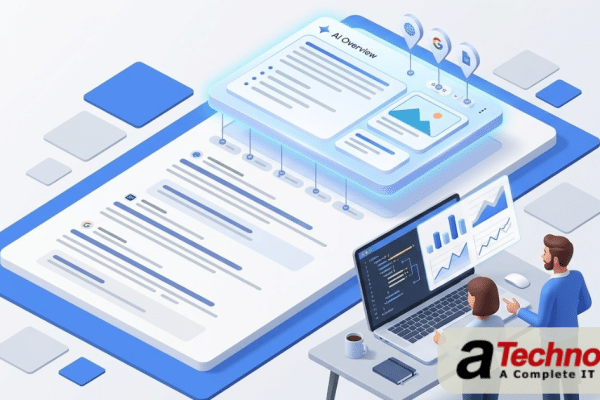
There’s a second shift happening too. AI tools like ChatGPT, Google AI Overviews, and Perplexity are now answering a growing share of search queries directly. The good news is that the sites AI engines trust and cite are, almost without exception, the same sites that already rank well organically — clean structure, clear answers, and real authority. Strong organic SEO is now the foundation for AI visibility as well.
The Organic SEO Framework We Use for US Clients
1. Fix the Technical Foundation First
No amount of content will rank on a slow, poorly indexed site. Before writing a single blog post, we check: is the site mobile-friendly, does it load under 2.5 seconds, is there a clean XML sitemap, and are there crawl errors blocking key pages? Google’s Core Web Vitals directly affect ranking, and a broken technical base wastes every dollar spent on content afterward.
2. Build Topical Authority, Not Just Keywords
Ranking for one keyword used to be enough. Today, Google rewards sites that cover a topic in depth — a hub page supported by a cluster of related articles, all internally linked. A US HVAC company, for example, shouldn’t just target “AC repair Dallas” — it should build out furnace maintenance, energy efficiency, seasonal checklists, and warranty guides, all linked back to the core service page. That depth is what separates page-one sites from the rest.
3. Earn E-E-A-T Signals
Experience, Expertise, Authoritativeness, and Trust are Google’s own stated ranking factors. Practically, this means real author bios, original data or case studies, genuine customer reviews, and backlinks from relevant, credible US sites — not spammy directories. Thin, AI-generated content with no real expertise behind it is increasingly filtered out of top rankings.
4. Structure Content So AI Engines Can Cite You
Clear H2/H3 headings, direct answers in the first two sentences of a section, and well-organized lists all make it easier for an AI system to lift your content into a summarized answer. Optimizing for organic rankings and optimizing for AI citations are now largely the same job — just written more clearly.
Common Mistakes That Keep US Websites Stuck on Page 2
- Keyword stuffing over clarity — modern algorithms reward natural language that actually answers the searcher’s question.
- Ignoring search intent — ranking a product page for an informational keyword (or vice versa) almost never works.
- No internal linking strategy — orphaned pages with no links pointing to them rarely rank, no matter how good the content is.
- Treating SEO as a one-time project — algorithms update constantly; a site optimized once in 2023 and left untouched will slide down over time.
- Chasing vanity keywords — ranking #1 for a term nobody searches, or that doesn’t convert, isn’t a win.
How Long Does Organic SEO Actually Take?
For most competitive US markets, meaningful movement takes 4-6 months, with compounding results building over 12+ months. Businesses that expect page-one rankings in a few weeks are usually the ones who give up right before the results arrive. Organic SEO is a compounding asset — every optimized page, every earned backlink, and every piece of topical content keeps working long after it’s published.
Getting Started
If your site hasn’t had a real technical and content audit in the last 12 months, that’s the right place to begin. We run structured organic SEO programs for US businesses built around exactly this framework — technical fixes, topical content clusters, authority building, and AI-search readiness working together instead of as separate projects. Explore our SEO services to see how we structure a 90-day organic growth plan.